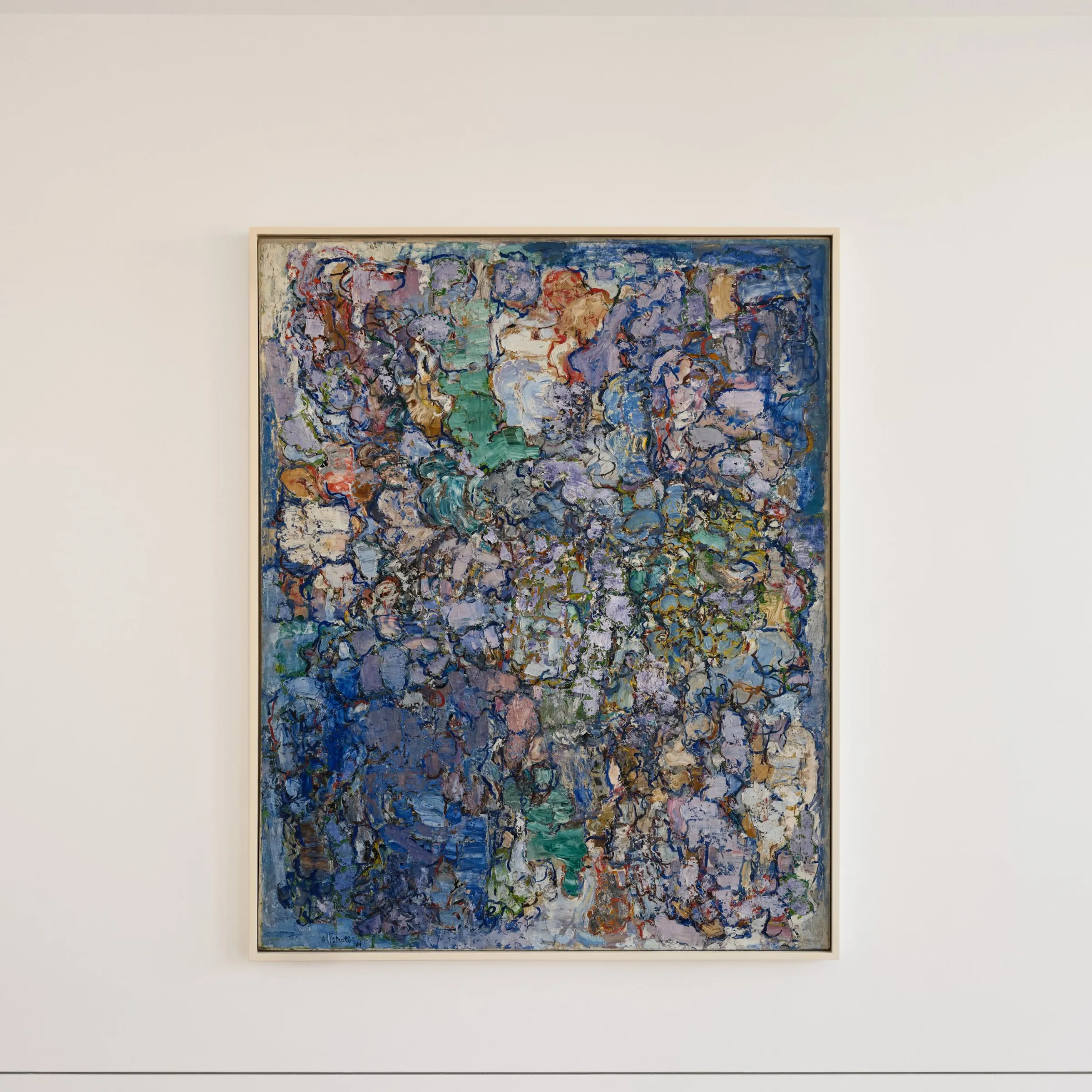
Alexandre Istrati
Alexandre Istrati was born on March 9, 1915, in Dorohoi, Romania. He began painting as a child, earned a law degree in 1937, and graduated from the Beaux-Arts in Bucharest, where he met the painter Natalia Dumitresco. They married in 1939.
In 1947, Istrati and Dumitresco received a bursary from the French government and moved to Paris. The Romanian-born sculptor Constantin Brancusi, who had lived and worked in Paris since 1904, welcomed them and gave them a studio next to his own on the impasse Ronsin, in the 15th arrondissement. It was in France that Istrati and Dumitresco discovered abstraction. Their friendship with Brancusi lasted until his death in 1957, and Brancusi named them executors of his will. In his will, dated 1956, Brancusi left his entire studio, with its finished works, sketches, tools, library, and photographs, to the French state, on the condition that the state reconstruct it as it was at his death.
Istrati’s first exhibition in Paris took place in 1949 at the Breteau gallery, and that year Colette Allendy introduced him to other abstract painters. In 1953, he won the Kandinsky Prize. After a brief period influenced by the Salon des Réalités Nouvelles, his painting moved toward free, lyrical abstraction. He worked with dripped paint reworked with a knife, in palettes of deep greens, bright violets, reds, and intense yellows. Later paintings were nearly bichromatic in red and blue, and in his later work he used lighter paint and thin, transparent stains of diluted color across large canvases.
In 1965, Istrati and Dumitresco became French citizens. The Galerie Hilt in Paris mounted Alexandre Istrati: Vingt ans à Paris, 1947–1967 in 1967, accompanied by a catalog, and in 1968 he exhibited at Galerie Daniel Gervis in Paris. In 1977, an exact replica of Brancusi’s studio, which Istrati and Dumitresco helped plan, was completed opposite the Centre Pompidou. In 1981, his work was included in Paris-Paris: Créations en France, 1937–1957 at the Centre Pompidou, and in 1983 he showed at the Artcur gallery in Paris. In 1986, he published with Dumitresco and the Swedish curator Pontus Hultén a book on Brancusi, Brancusi, issued by Flammarion. The exhibition catalog Istrati, Dumitresco: une histoire de peintres followed in 1989, published by Artcurial.
Istrati died in Paris on October 28, 1991. He is buried in the Montparnasse Cemetery, in the same grave as Dumitresco and Brancusi. His work can be found in institutional collections including the Museo Nacional Centro de Arte Reina Sofía in Madrid, which holds two of his Compositions, and the Picker Art Gallery at Colgate University, which holds his oil painting Red (1958), a gift of Herbert Mayer. In 2007, he was included in Ateliers: L’artiste et ses lieux de création at the Centre Pompidou.
Sources: Centre Pompidou, Galerie Hervé Courtaigne, and Wikipedia