Vivian Springford
Vivian Springford was born in Milwaukee, Wisconsin, on February 1, 1913. Her family moved to Detroit in 1926 and to New York in 1930, when her father, Herbert Henry Springford, became president of the refrigerator manufacturer Servel, Inc. She graduated from the Spence School in New York in 1932. That year, she began studying at the Art Students League, where she trained under Robert Brackman and Jon Corbino until 1946. During the 1930s and 1940s, she worked as a commercial illustrator and portraitist, producing portraits for New York newspapers and illustrations for Albert Carr’s 1939 book Juggernaut.
In the mid-1950s, Springford met the Chinese-American painter Walasse Ting, who introduced her to Asian art and culture. Her paintings of the period took up the gestural language of Abstract Expressionism alongside influences from East Asian art, including Chinese calligraphy, Taoism, and Confucianism. In 1959, her work was exhibited at the National Academy of Design. In 1960, she held her first solo exhibition at the Great Jones Gallery in New York, followed by group exhibitions at the Balin Traube Gallery in 1962 and a solo exhibition at the Preston Gallery in 1963.
By 1970, Springford had developed a stain-painting technique, pouring thinned pigment onto unprimed canvas. In 1970, she showed at the Esther Bear Gallery in Santa Barbara, California, and in 1971 at the Bertha Schaeffer Gallery in New York. In 1975, she was included in Women Artists: Works on Paper at the Brooklyn Museum and held a solo exhibition at the Dorothy Yepez Gallery Without Walls in Saranac Lake, New York, marking International Women’s Year. Her work traveled in the WIA Foundation’s Artists’ Choice exhibition in 1976–1977. She exhibited with the Visual Arts Coalition at the Cork Gallery at Lincoln Center in 1978 and at Marymount Manhattan College in 1979. Also in 1979, she held a solo exhibition, Paintings & Paper Works, at Saint Peter’s Church in the Citicorp Building.
From the 1980s, macular degeneration and declining health limited Springford’s ability to paint, and she had stopped working by the 1990s. Her paintings remained in storage until the late 1990s, when Gary Snyder Fine Art in New York presented Vivian Springford: Abstract Expressionist Painting, 1956–1988 in 1998.
Vivian Springford died in New York on January 14, 2003. Later that year, Gary Snyder Fine Art mounted West Meets East: A Memorial Exhibition. Posthumous exhibitions have included Vivian Springford: A Retrospective at Peyton Wright Gallery in Santa Fe in 2014, as well as solo exhibitions at Almine Rech in New York in 2018 and 2020, and at the Phillips Museum of Art at Franklin & Marshall College in Lancaster, Pennsylvania, in 2021. Her work was included in Women of Abstract Expressionism at the Denver Art Museum in 2016. It was also included in Action, Gesture, Paint: Women Artists and Global Abstraction 1940–70 at the Whitechapel Gallery in London and the Fondation Vincent van Gogh in Arles in 2023. Her work can be found in public collections including the Solomon R. Guggenheim Museum, Museum of Fine Arts, Boston, Brooklyn Museum, Kunstmuseum Basel, and Phillips Museum of Art, as well as the JPMorgan Chase Art Collection.
Sources: Almine Rech and Wikipedia
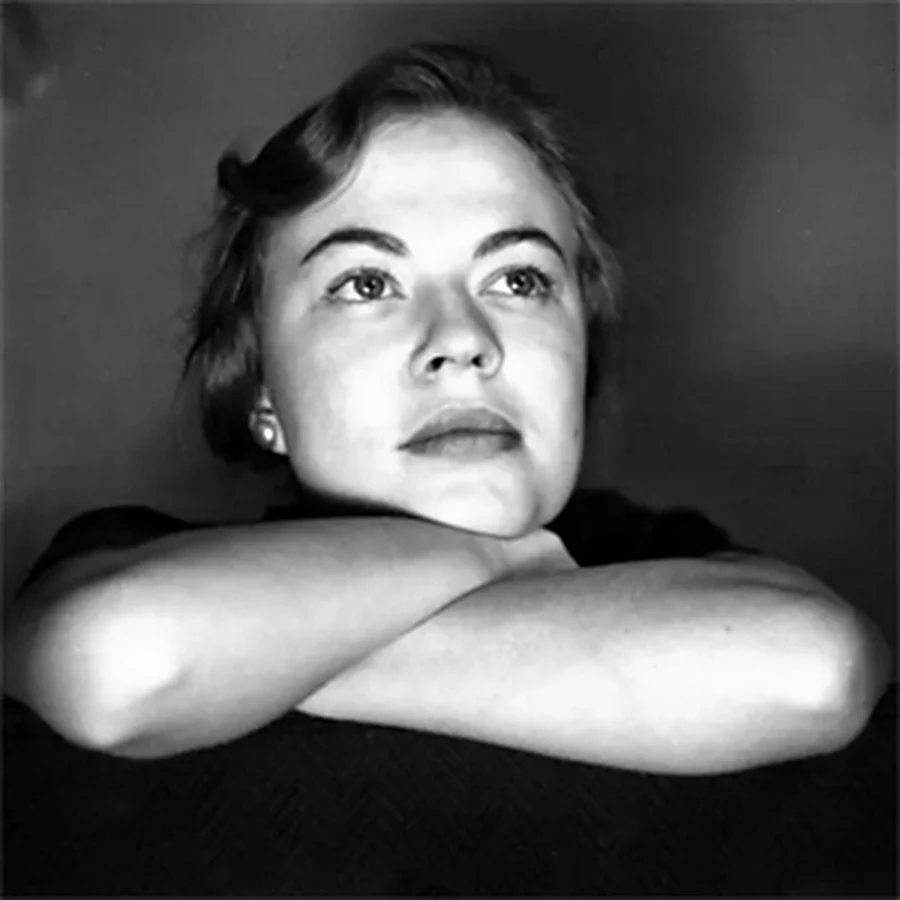
Vivian Springford was born in Milwaukee, Wisconsin, on February 1, 1913. Her family moved to Detroit in 1926 and to New York in 1930, when her father, Herbert Henry Springford, became president of the refrigerator manufacturer Servel, Inc. She graduated from the Spence School in New York in 1932. That year, she began studying at the Art Students League, where she trained under Robert Brackman and Jon Corbino until 1946. During the 1930s and 1940s, she worked as a commercial illustrator and portraitist, producing portraits for New York newspapers and illustrations for Albert Carr’s 1939 book Juggernaut.
In the mid-1950s, Springford met the Chinese-American painter Walasse Ting, who introduced her to Asian art and culture. Her paintings of the period took up the gestural language of Abstract Expressionism alongside influences from East Asian art, including Chinese calligraphy, Taoism, and Confucianism. In 1959, her work was exhibited at the National Academy of Design. In 1960, she held her first solo exhibition at the Great Jones Gallery in New York, followed by group exhibitions at the Balin Traube Gallery in 1962 and a solo exhibition at the Preston Gallery in 1963.
By 1970, Springford had developed a stain-painting technique, pouring thinned pigment onto unprimed canvas. In 1970, she showed at the Esther Bear Gallery in Santa Barbara, California, and in 1971 at the Bertha Schaeffer Gallery in New York. In 1975, she was included in Women Artists: Works on Paper at the Brooklyn Museum and held a solo exhibition at the Dorothy Yepez Gallery Without Walls in Saranac Lake, New York, marking International Women’s Year. Her work traveled in the WIA Foundation’s Artists’ Choice exhibition in 1976–1977. She exhibited with the Visual Arts Coalition at the Cork Gallery at Lincoln Center in 1978 and at Marymount Manhattan College in 1979. Also in 1979, she held a solo exhibition, Paintings & Paper Works, at Saint Peter’s Church in the Citicorp Building.
From the 1980s, macular degeneration and declining health limited Springford’s ability to paint, and she had stopped working by the 1990s. Her paintings remained in storage until the late 1990s, when Gary Snyder Fine Art in New York presented Vivian Springford: Abstract Expressionist Painting, 1956–1988 in 1998.
Vivian Springford died in New York on January 14, 2003. Later that year, Gary Snyder Fine Art mounted West Meets East: A Memorial Exhibition. Posthumous exhibitions have included Vivian Springford: A Retrospective at Peyton Wright Gallery in Santa Fe in 2014, as well as solo exhibitions at Almine Rech in New York in 2018 and 2020, and at the Phillips Museum of Art at Franklin & Marshall College in Lancaster, Pennsylvania, in 2021. Her work was included in Women of Abstract Expressionism at the Denver Art Museum in 2016. It was also included in Action, Gesture, Paint: Women Artists and Global Abstraction 1940–70 at the Whitechapel Gallery in London and the Fondation Vincent van Gogh in Arles in 2023. Her work can be found in public collections including the Solomon R. Guggenheim Museum, Museum of Fine Arts, Boston, Brooklyn Museum, Kunstmuseum Basel, and Phillips Museum of Art, as well as the JPMorgan Chase Art Collection.
Sources: Almine Rech and Wikipedia